

In fact we may have to go back to the story of Mary the mother of Jesus to unwrap all that happened, and grasp the significance of it. Then again, we will need to go back much further to the story of Adam and Eve to really get the whole picture. That is because Jesus is called the last Adam.
According to the Genesis account, Adam and Eve lived in a state of innocence. They were unaware of, and unaffected by, the influence of evil. Had they not been deceived by the serpent to disobey the instructions of the Lord God, there was the potential to live forever, although it seems that immortal life still had to come from an outside source, the tree of life. Man did not possess the ability to live forever apart from something God provides.
But, as we see in the words of Genesis, eating from the fruit of the tree of the knowledge of good and evil released serious consequences for mankind and the earth. Of particular interest to us is the original warning from the Lord God, “when you eat of it, you will die.” The Hebrew phrase is more accurately, “dying, you shall die.” It was a judicial verdict, issued on the day they ate the fruit, that death would now be a certainty for them. We see this explained in the curses of Genesis 3, where Adam is told “til you return to the ground, for out of it you were taken; for you are dust, and to dust you shall return.”
From Bright Morning Star

It must be noted that God did not say “your body will die, but you will continue to live in another realm.” There is no indication in this passage that death was anything other than the absence of life. To suggest otherwise does not take seriously their expulsion from the garden, and the angelic guard posted there to prevent them from eating from the tree of life, “lest they live forever.” The plain meaning of returning to dust would be that life is no longer present, the same condition Adam was in before God breathed life into him.
The apostle Paul confirms this view in Romans 5:12, where he says,
“Therefore just as sin came into the world through one man, and death through sin, and so death spread to all men because all sinned…”
This explains why Jesus had to be born of a virgin. Jesus would have been born into sin if he was conceived by an earthly father. Because he was conceived by the Holy Spirit, he was in the same state of innocence that Adam originally possessed, making him the last Adam, the one who would choose to say no to the temptation presented by the devil. This would enable him to become the perfect sacrifice for our sins. He had to be human to be able to die, and he had to be the sinless Son of God to become the perfect Lamb.
We do not understand death today in the same way the Old and New Testaments portray it. Our contemporary belief that death only happens to the body, and the soul or spirit continues to live on in another realm, is nowhere to be found in the scriptures. Humans are referred to as mortal beings in many places within the pages of our Bible. One of the most familiar is Isaiah 40:6-8.
“All flesh is grass, and all its beauty is like the flower of the field. The grass withers, the flower fades when the breath of the Lord blows on it; surely the people are grass. The grass withers, the flower fades, but the word of our God will stand forever.”
This passage is a comparison and contrast. Humans are similar to flowers and grass, in that their lives both come to an end. Humans are different from the word of God, which lasts forever. If the writer of Isaiah believed that humans were already immortal, both his comparison and his contrast fall apart.
In the book of Daniel, Daniel has an encounter with a powerful angel sent to him in response to his prayer and fasting for twenty one days. The angel tells Daniel many things about what will transpire in history and specifically in the end times. He says in Daniel 12:2,
“And many of those who sleep in the dust of the earth shall awake, some to everlasting life, and some to shame and everlasting contempt.”
The angel is revealing the resurrection of the saints and the wicked at the return of Jesus Messiah. He informs Daniel that the dead are asleep in the ground until that time. He also tells Daniel himself to look forward to his reward at the end, not when he dies. This is verse 13, the final instruction to Daniel:
“But go your way till the end. And you shall rest and shall stand in your allotted place at the end of the days.”
Even Daniel is told that he will rest, another word for sleep, until he is awarded a place in the kingdom at the end.
In the New Testament, Jesus makes a claim about Himself that is very familiar, yet it seems that the real meaning of his words has been missed. It is John 3:16.
“For God so loved the world that he gave his only Son, that whoever believes in him should not perish, but have eternal life.”
According to Jesus’ own words, he is making a way for those who will believe in him to experience eternal life, or, we might call it, immortality. He is, in essence, bringing the tree of life back into view. Not for everyone, but only for those who can see it. It is important to note that only those who believe will receive this immortality. Those who do not believe will perish. The Greek word for perish means to destroy, or to destroy utterly.
Death, the physical death which everyone experiences at some point, is called Sheol in the Old Testament. It is the end of living, awareness, and consciousness. The Psalmist pleaded with God to keep him from going there, precisely because it was the end of those things, and the end of being able to offer praise to God or have a relationship with Him. It was called the place of silence.
The significance of Jesus being raised from the dead cannot be overstated. He was the first human being in the history of mankind to return from that state of death to life that will never end, one that is free from the limitations placed on us by the disobedience of Adam and Eve. But we must realize: he was actually dead until he was raised. Peter tells the people in his first message following Pentecost:
“this Jesus, delivered up according to the definite plan and foreknowledge of God, you crucified and killed by the hands of lawless men. God raised him up, loosing the pangs of death, because it was not possible for him to be held by it.”
Acts 2:23-24
It was only resurrection that freed Jesus from the devestating consequences of death. Jesus acknowledges this when he appears to John in Revelation 1:17-18.
“Fear not, I am the first and the last, and the living one. I died, and behold I am alive forevermore, and I have the keys of Death and Hades.”
Jesus is assuring John that even though he actually died, because of resurrection he is now alive forever. As a result of being raised, he was then able to descend into the earth and obtain the keys of death and the grave. These are the keys which will, at the last trumpet, release all the redeemed ones from death to immortal life. That is why the gates of Hades (Sheol, or the grave) will not prevail against those who are His. Jesus will at that time open the gates of death to bring His own back to life, because he has the keys, which he was able to take from the devil because of the power and authority he received as a result of being raised from the dead himself.
The apostle Paul confirms this view in 1 Thessalonians 4:13-18. The hope he offers to those whose believing loved ones have died is that even though they are now asleep in the ground, they will be raised from the dead at the sound of the shout and the trumpet blast (the keys opening the gates) to meet the Lord in the air, and then those still living will be changed and join the now resurrected ones in the air.
Paul confirms this in 1 Corinthians 15. He says of first importance is that
Christ died for our sins in accordance with the scriptures, that he was buried, that he was raised on the third day in accordance with the scriptures, and that he appeared to Cephas, then to the twelve.”
Jesus could not appear to his disciples until he was raised, because he truly died. He was in the place of the grave until he arose. Peter explained this in Acts 2:27, quoting from Psalm 16:
“For you will not abandon my soul to Hades (Sheol, the place of the grave), or let your Holy One see corruption (decay).”
It was resurrection on the third day that fulfilled this for Jesus. We know this is so because Peter goes on to explain that David is still in his grave. This was a prophetic Psalm that was only fulfilled by Jesus being raised from the dead. Peter explains that David did not ascend to heaven (he is still dead).
Paul also says in 1 Corinthians 15:20-23:
“But in fact Christ has been raised from the dead, the first fruits of those who have fallen asleep. For as by a man came death, by a man has come also the resurrection from the dead. For as in Adam all die, so also in Christ shall all be made alive. But each in his own order: Christ the firstfruits, then at his coming those who belong to Christ.”
1 Corinthians 15:20-23
The plain meaning of this is that all who have died are dead until Christ makes them alive again—by raising them from the dead.
Our modern day theology says that when someone dies, the soul or spirit goes directly to heaven or hell. But this contradicts what Peter said about David. Peter said David did not ascend to heaven. The other issue we need to confront is that every scripture in the New Testament that talks about our future hope frames it in terms of what happens when Jesus returns to earth. Death is never described as the transition to glory, resurrection is. Because we are mortal beings, we are dependent on God raising us from the grave to enable us to live beyond death. This future hope is demonstrated by Romans 8:23-24.
“And not only the creation, but we ourselves, who have the firstfruits of the Spirit, groan inwardly as we wait eagerly for adoption as sons, the redemption of our bodies. For in this hope we were saved. Now hope that is seen is not hope. For who hopes for what he sees?”
Paul says clearly here that what we are anxiously awaiting is the resurrection of our bodies, not a transfer to heaven as a spirit being. Our hope is fulfilled when Jesus raises us from the dead. This excludes our hope being fulfilled at death. That is because, since we are still children of Adam, we are not now immortal.
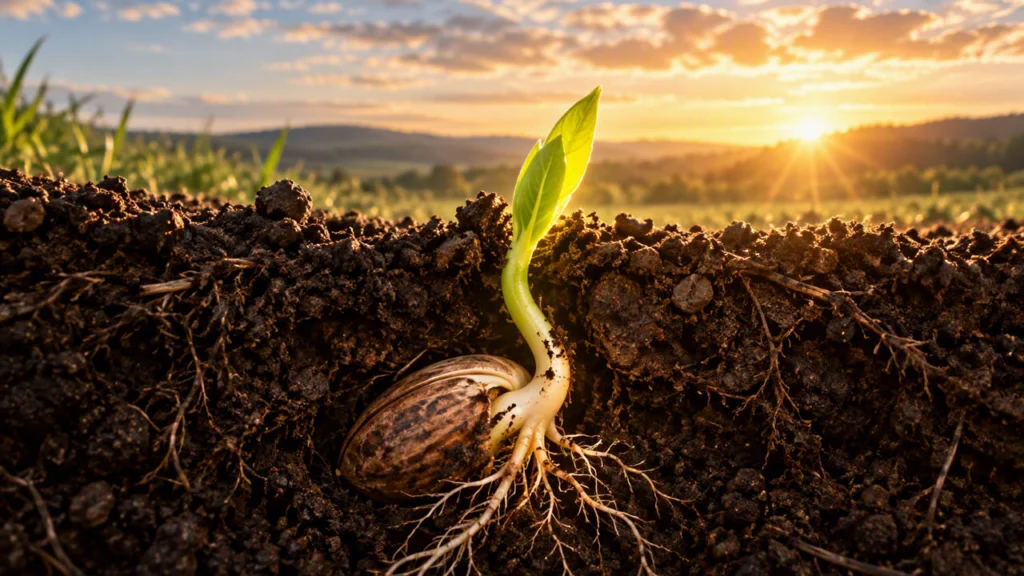
Paul compares death to the planting of a seed in 1 Corinthians 15:42-44. The seed is perishable, it is in dishonor, it is weak, and it is natural. It is only at resurrection that it becomes imperishable, glorious, powerful, and spiritual. He then says that for now we are like Adam, the man of dust, but we will someday become like the man who came from heaven, Jesus (vs. 49). When does this change occur?
“In a moment, in the twinkling of an eye, at the last trumpet. For the trumpet will sound, and the dead will be raised imperishable, and we shall be changed. For this perishable body must put on the imperishable, and this mortal body must put on immortality.” (vs. 52-53)
We are not changed until Jesus returns with the sound of the trumpet. He shatters the gates of Sheol, and raises us up from the dead to become immortal, imperishable humans beings who will forever be with Him.
Death cannot change us, only resurrection can. That is why Paul calls His appearing the Blessed Hope. We are mortal and perishable until He raises us from the dead. Then we assume glorified bodies just like the body of Jesus.
John confirms this in 1 John 3:2, which says
“Beloved, we are God’s children now, and what we will be has not yet appeared; but we know that when he appears we shall be like him, because we shall see him as he is.”
1 John 3:2
It is not until He returns that we will be changed, because it is then that we will see him as he is. If we do not see him as he is until he appears, then we could not be in heaven before he appears, because we would have already seen him as he is.
The resurrection of Jesus from the dead is truly the centerpiece of our faith. His resurrection was necessary to defeat the death that spread to all men as a result of Adam’s failure, and our resurrection from the dead at the return of Messiah Jesus to earth changes us to become immortal sons and daughters of God, permanently adopted into the family of God. Our resurrection from the dead is the fulfillment of our hope for eternal life.
Even so come, Lord Jesus!