
When God’s people returned to the Promised Land from their exile in Babylon, they needed hope–hope that they could be restored to the place of fruitful service to God despite their past failings. And they found hope in these words from Isaiah:
Even youths grow tired and weary, and young men stumble and fall; but those who hope in the LORD will renew their strength. They will soar on wings like eagles; they will run and not grow weary, they will walk and not be faint.
Isaiah 40:30-31
As Peter tried to return to the Promised Land of following Jesus after an “exile” caused by Peter denying Jesus three times, he also needed such hope in the LORD–hope that he could be restored to the place of fruitful service to God despite his abysmal past failings.
Peter knew that he had started well in following Jesus. How could he ever forget that thrilling day when Jesus first called him to stop being a fisherman so that he could become a fisher of men?
It had happened several years earlier when Peter had “worked hard [fishing] all night and [hadn’t] caught anything” (Luke 5:5). When Peter followed Jesus’ command to try again in deeper water, Peter “caught such a large number of fish that [the] nets began to break” (Luke 5:6). Peter was so “astonished at the catch of fish” (Luke 5:9) that “he fell at Jesus’ knees and said, ‘Go away from me, Lord; I am a sinful man!’” (Luke 5:8). Nevertheless, “Jesus said to [Peter], ‘Don’t be afraid; from now on you will catch [people].’ So [Peter] pulled [his] boat[] up on shore, left everything and followed him” (Luke 5:10-11).
For awhile all went well as Peter followed Jesus. In particular, Peter did well when he became the first disciple to tell Jesus: “You are the Christ, the Son of the living God” (Matthew 16:16). I’m sure Peter never forgot the thrill when Jesus replied:
“Blessed are you, Simon son of Jonah, for this was not revealed to you by man, but by my Father in heaven. And I tell you that you are Peter, and on this rock I will build my church, and the gates of Hades will not overcome it. I will give you the keys of the kingdom of heaven; whatever you bind on earth will be bound in heaven, and whatever you loose on earth will be loosed in heaven.” (Matthew 16:17-19)
Then the problems started. After receiving this blessing, Peter began to get an inflated ego, becoming a “legend in his own mind.” Peter began thinking that he knew better than Jesus. Indeed, Peter was not shy about telling Jesus what to do.
The first example of Peter’s ego problem occurred almost immediately after Jesus praised him for recognizing that Jesus was the Christ, the Son of the living God.
“From that time on Jesus began to explain to his disciples that he must go to Jerusalem and suffer many things at the hands of the elders, chief priests and teachers of the law, and that he must be killed and on the third day be raised to life” (Matthew 16:21).
Peter did not agree that this was what should befall the Christ, the Son of the living God. “Peter took [ Jesus] aside and began to rebuke him, ‘Never, Lord!’ he said. ‘This shall never happen to you!”‘ (Matthew 16:22). Jesus did not mince words telling Peter that he was wrong. “Jesus turned and said to Peter, ‘Get behind me, Satan! You are a stumbling block to me; you do not have in mind the things of God, but the things of men.’” (Matthew 16:23)
Despite this stern rebuke, Peter didn’t learn his lesson. A mere six days later (Matthew 17:1) he again made the mistake of giving Jesus bad advice.
It happened during the event known as the Transfiguration. “Jesus took Peter, James and John with him and led them up a high mountain where … he was transfigured before them. His clothes became dazzling white, whiter than anyone in the world could bleach them. And there appeared before them Elijah and Moses, who were talking with Jesus” (Mark 9:2-4).
Peter “did not know what to say, they were so frightened” (Mark 9:6). But did this stop Peter from blurting out advice to Jesus? Of course not!
“Peter said to Jesus, ‘Rabbi, it is good for us to be here. Let us put up three shelters–one for you, one for Moses and one for Elijah.”‘ (Mark 9:5).
The Bible does not explain what was wrong with this advice. I’ve heard several ideas that underscore Peter’s error.
First of all, Peter was implying an equality between Jesus, Moses and Elijah. However, as the book of Hebrews explains at length, Jesus is far superior to any human, including humans as great as Moses and Elijah. Because Jesus Christ is the Messiah, the Son of the living God. Second, Peter erred when he thought that following Jesus meant establishing fancy shrines. Peter still had to learn that following Jesus does not mean sitting down on a mountain top in dazzling clothes basking in glory. Following Jesus means taking up your cross and bearing it daily, no matter where such faithfulness leads you and no matter how much it costs you–even if it leads to your crucifixion.
Above all, Peter’s error was his presumption that it was more important for Jesus to listen to Peter than for Peter to listen to Jesus. God the Father wasted no time setting Peter straight. “[A] cloud appeared and enveloped them, and a voice came from the cloud: ‘This is my Son, whom I love. Listen to him!’” (Mark 9:7).
Nevertheless, Peter still did not learn his lesson. He failed Jesus again by his words and conduct on the night of the Last Supper–the night Jesus was betrayed by Judas and denied by Peter.
Right from the start of the Last Supper, Peter kept saying “the wrong thing.” Jesus wanted to show the disciples that they should serve each other as symbolized by washing each other’s feet (John 13:14-15). “[S]o he got up from the meal … and began to wash his disciples’ feet” (John 13:4-5). When Jesus came to Peter, he objected. “‘No,’ said Peter, ‘you shall never wash my feet.’” (John 13:8). Jesus insisted, saying, “Unless I wash you, you have no part with me” (John 13:8). Now the irrepressible Peter went overboard the other way, replying, “Then, Lord, … not just my feet but my hands and my head as well!” (John 13:9). So Jesus had to explain to Peter why he only needed to have his feet washed (John 13:10). A bit later in the meal, Peter proved again that he could not seem to listen and learn from Jesus. Jesus warned him: “Simon, Simon, Satan has asked to sift you as wheat. But I have prayed for you, Simon, that your faith may not fail. And when you have turned back, strengthen your brothers” (Luke 22:31-32). Instead of listening to this warning, Peter argued with Jesus. He replied: “Lord, I am ready to go with you to prison and to death”. (Luke 22:33)
Despite Peter’s boasting, Jesus knew that despair and fear would grip Peter’s heart later that night. Jesus warned him again: “I tell you, Peter, before the rooster crows today, you will deny three times that you know me” (Luke 22:34).
When they went to the olive grove in Gethsemane, Peter again failed to listen to Jesus and follow his advice. Jesus told Peter: “My soul is overwhelmed with sorrow to the point of death. Stay here and keep watch with me” (Matthew 26:38). Nevertheless, when Jesus checked on his disciples a while later, he “found them sleeping. ‘Could you men not keep watch with me for one hour?’ he asked Peter. ‘Watch and pray so that you will not fall into temptation. The spirit is willing, but the body is weak.’” (Matthew 26:40-41).
Despite this rebuke, Peter still failed to listen to Jesus and follow his advice. Because when Jesus came back after praying, “he again found them sleeping” (Matthew 26:43).
The only way left for Peter to learn was the hard way. He was going to learn what happens when “Satan … sift[s] you as wheat” (Luke 22:31). He was going to learn what happens when you hear the words of Jesus and do not put them into practice, becoming “like a foolish man who built his house on sand” (Matthew 7:26). He was going to find out what it is like when “[t]he rain [comes] down, the streams [rise], and the winds [blow] and beat against that house, and it [falls] with a great crash” (Matthew 7:27). Peter learned these bitter lessons in the courtyard of the high priest, as Jesus was being condemned. When Jesus most needed Peter’s friendship,
Peter denied three times that he even knew Jesus. As Peter shouted his denial, [t]he Lord turned and looked straight at Peter. Then Peter remembered the word the Lord had spoken to him: “Before the rooster crows today, you will disown me three times.” And he went outside and wept bitterly. (Luke 22:60-62)
This picture of Peter weeping bitterly was the last we saw of Peter until Mary Magdalene ran to tell him that the tomb was empty on that first Easter morning. “Peter … got up and ran to the tomb. Bending over, he saw the strips of linen lying by themselves, and he went away, wondering to himself what had happened” (Luke 24:12).
By the evening of that first Easter, however, Peter knew the truth- Jesus was alive! Because when the two men who met Jesus on the road to Emmaus returned to Jerusalem that evening they heard: “It is true! The Lord has risen and has appeared to Simon [Peter]” (Luke 24:34).
We do not know any details of that first time that Peter met his risen Lord. But the Gospel of John provides a detailed account of a later meeting between Peter and Jesus.
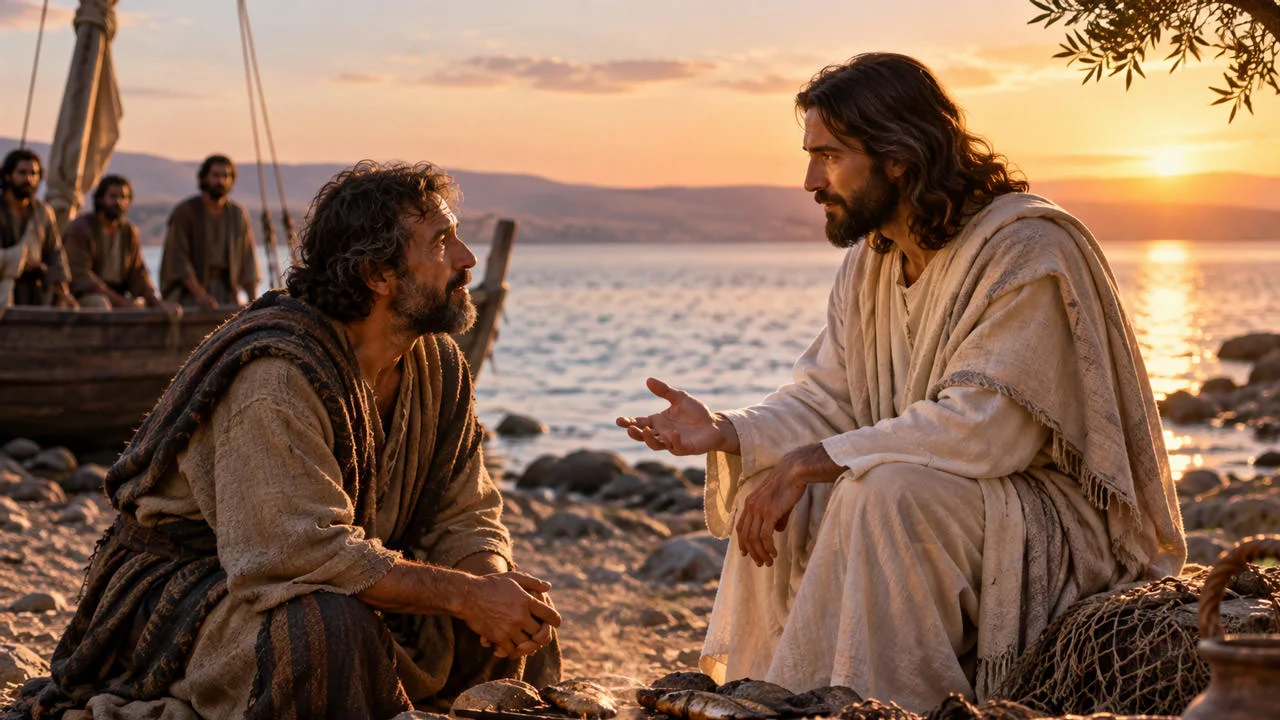
This meeting took place near the Sea of Galilee while Peter was fishing. The circumstances were designed to remind Peter of that first time when Jesus called him to become a fisher of men. Once again Peter had fished all night without success. Once again, Jesus urged him to try again. And once again, Peter caught a huge number of fish (John 21:1-6).
Peter was overjoyed when he realized that Jesus had come again. In his enthusiasm to join Jesus, the always impulsive and irrepressible Peter “wrapped his outer garment around him (for he had taken it off) and jumped into the water” (John 21:7).
After the other disciples brought the boat into shore (John 21:8), Peter and the other disciples accepted Jesus’ invitation: “Come and have breakfast” (John 21:12). (Jesus had already prepared “a fire of burning coals there with fish on it, and some bread” (John 21:9)).
Then a shadow fell across the fellowship between Peter and Jesus. Peter had failed to listen to Jesus so often. Most of all, Peter had failed Jesus in that critical moment of testing when Peter denied Jesus three times.
Now, with other disciples there, Jesus knew that the time was right to clear the air between Peter and him. To let the other disciples know that Peter was fully forgiven. To let Peter and the rest of the disciples know that Jesus still had a purpose for Peter’s life despite all his failures and failings. To heal Peter’s Promised Land.
Peter had denied knowing Jesus three times. Now Peter told Jesus three times that he loved him (John 21:15-17).
Peter had often acted as if he knew more than Jesus. Now Peter admitted: “Lord, you know all things; you know that I love you” (John 21:17).
Jesus put hope back into Peter’s heart.
Yes, Peter had failed. He had fallen away from Jesus at a dark moment when Satan sifted him like wheat.
But now Jesus gave Peter hope that he would never deny Jesus again. Jesus predicted (correctly, according to tradition) that Peter would be crucified for following Jesus (John 21:18-19). So, in the end, Peter would indeed keep the promise he made to Jesus at the Last Supper: “I will lay down my life for you” (John 13:37).
Furthermore, Jesus put purpose back into Peter’s life. Despite the fact that Peter had failed Jesus in the past, Jesus still wanted Peter to be a fisher of men instead of a fisherman.
Jesus still wanted Peter to “[f ]eed my lambs,” “[t]ake care of my sheep,” and “[f]eed my sheep” (John 21:15-17).
So no matter how badly you’ve failed Jesus, never lose hope.
It doesn’t matter exactly why and how you’ve failed Jesus. Perhaps you fell away because of troubles or persecutions. Or perhaps your fruitfulness was choked by worries, the deceitfulness of wealth, or the desire for other things.
Jesus still knows all things. Jesus still knows you love him.
Furthermore, Jesus still has a purpose for your life. There are many ways to care for his sheep–to bless all peoples in the Promised Land by becoming their “best friend.”
You may be best at weeping with those who weep. You may be best at washing people’s feet. You may be best at welcoming sinners. Or you may be best at taking children in your arms and blessing them.
Jesus still calls you–as he called Peter–with this command and with this challenge: “Follow me!” (John 21:19). And if you follow Jesus, he will carry you across oceans of denials and failures until you reach the Promised Land.
Therefore, follow Jesus as he calls you back home from the exile of your failures–as he heals your Promised Land. Follow Jesus as he brings hope to your heart–as he gives you the strength to establish the work of your hands in the Promised Land.
Follow Jesus as he gives purpose to your life–as he gives you the joy and peace that come from lighting the world by blessing all peoples in the Promised Land.
Follow Jesus Christ because he rose from the dead, proving that in the Promised Land:
[T]hose who hope in the LORD will renew their strength.
Isaiah 40:31
They will soar on wings like eagles;
they will run and not grow weary,
they will walk and not be faint.