
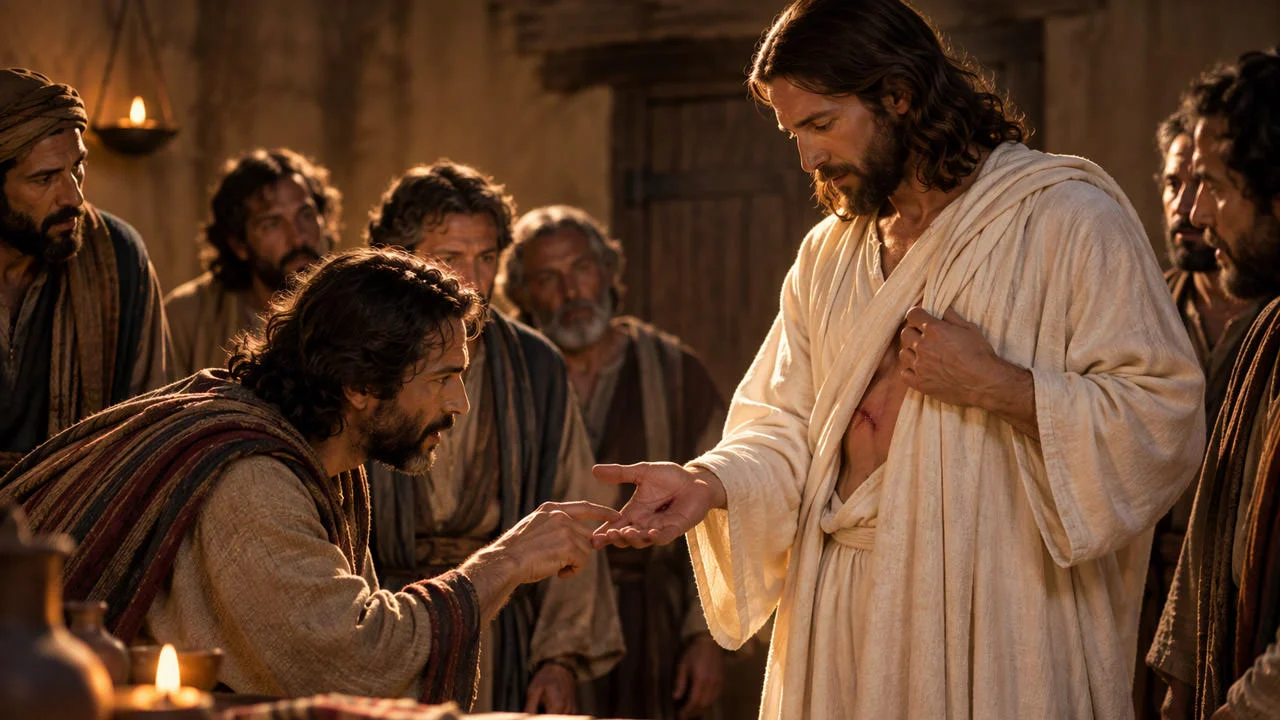
Some of us have to wait longer than others until we see and hear Jesus clearly–until he enters the locked rooms of our hearts.
“Now Thomas (called Didymus), one of the Twelve, was not with the disciples when Jesus came” (John 20:24). Thomas became one of those people who have to wait longer than most to see and hear Jesus clearly. In fact, Thomas had to wait until he could feel the risen Jesus enter the locked rooms of his heart. And so, he has become famous as “Doubting Thomas.” It wasn’t enough for Doubting Thomas that “the other disciples told him, ‘We have seen the Lord!’” (John 20:25). Doubting Thomas insisted, “Unless I see the nail marks in his hands and put my finger where the nails were, and put my hand into his side, I will not believe it” (John 20:25).
It wasn’t enough for Doubting Thomas that Mary Magdalene and the other women had seen the empty tomb and spoken with the risen Jesus (Matthew 28:1-10).
It wasn’t enough for Doubting Thomas that the two men walking to Emmaus had recognized Jesus and become convinced that, according to the Scriptures, “the Christ [had] to suffer these things and then enter his glory” (Luke 24:26).
It wasn’t enough that many disciples saw Jesus in the locked room that first Easter evening and heard him say: “Peace be with you!” (John 20:19; Luke 24:36).
It wasn’t even enough that the disciples had made sure that first Easter evening that Jesus was truly risen from the dead. Because, with Jesus’ encouragement, they made sure that Jesus was not a ghost or a hallucination.
At first “[t]hey were startled and frightened, thinking they saw a ghost” (Luke 24:37). But Jesus reassured them. “He said to them, ‘Why are you troubled, and why do doubts rise in your minds? Look at my hands and my feet. It is I myself! Touch me and see; a ghost does not have flesh and bones, as you see I have.’” (Luke 24:38-39).
After “he showed them his hands and feet … they still did not believe it because of joy and amazement” (Luke 24:40-41). So Jesus offered further physical proof that he was not a ghost or a hallucination. “[H]e asked them, ‘Do you have anything here to eat?’ They gave him a piece of broiled fish, and he took it and ate it in their presence” (Luke 24:41-43).
Having established the physical basis for believing he was alive, Jesus proceeded to establish the theological basis for believing he was alive and that he was the Messiah (called the “Christ” in Greek). “He said to them, ‘This is what I told you while I was still with you: Everything must be fulfilled that is written about me in the Law of Moses, the Prophets and the Psalms.’” (Luke 24:44). The reference to “the Law of Moses, the Prophets and the Psalms” covers all of our Old Testament. And, as we have seen time and again, Jesus found passages from throughout the Old Testament that guided him in his ministry and foretold what would befall him.
Many of the passages from the Old Testament Scriptures that are referred to in our New Testament Scriptures presumably were cited by Jesus himself to these first disciples. Because “he opened their minds so they could understand the Scriptures. He told them, ‘This is what is written: The Christ will suffer and rise from the dead on the third day, and repentance and forgiveness of sins will be preached in his name to all nations, beginning at Jerusalem.’” (Luke 24:45-47).
None of these eyewitness accounts was good enough for Doubting Thomas. Nor was he convinced merely by studying the Old Testament passages that the other disciples now realized were proof that Jesus was the Messiah.
Nevertheless, Doubting Thomas did one thing right. He continued meeting with those who had no such doubts. And, therefore, “[a] week later [when Jesus’] disciples were in the house again, … Thomas was with them.’” (John 20:26). Doubting Thomas was present this time when Jesus came again to remove all doubts.
Just as on that first Easter evening one week before, “the doors were locked” (John 20:26). Nevertheless, the risen “Jesus came and stood among them and said, ‘Peace be with you!’” (John 20:26). This was the same greeting he had used the week before (John 20:19). This time Doubting Thomas was there to receive the peace that only the risen Lord Jesus Christ can give.
Jesus turned his attention directly to him and “said to Thomas, ‘Put your finger here; see my hands. Reach out your hand and put it into my side. Stop doubting and believe.’” (John 20:27). Now Doubting Thomas had the physical proof he needed. And he’d learned the theological significance of Jesus’ death and resurrection from the Scriptures. His physical experiences and his intellectual knowledge complemented and illuminated each other.
Thomas stopped doubting and believed. “Thomas said to [ Jesus], ‘My Lord and my God!’” (John 20:28). When you have intellectual doubts about the truth regarding God, do not lose hope. Everyone feels doubts and confusion sometimes in the face of tragedies or skepticism. The important thing is never to give up your search for the truth despite your doubts. Because, if you persevere, Jesus will eventually satisfy your questioning. Thomas’ experiences as a doubter shed light on how to overcome such doubts.
First and foremost, do not stop gathering with other followers of Jesus! Even though you have doubts, stay near those who are patient enough to help you through your time of doubting.1
Second, do not limit yourself to one approach to perceiving truth. The doubts of Doubting Thomas come easily to those steeped in modern science. It is hard to find that intellectual balance between what physical evidence can prove and what the Scriptures teach. But never lose hope that, when properly understood, Science and the Scriptures will complement and illuminate each other.
There are several ways to think about this.
One way is to think of Science and the Scriptures as two different tools for discovering the truth about the universe. Just as both a microscope and a telescope are useful tools for discovering truth, both Science and the Scriptures are useful for discovering truth. But if we use the wrong tool to try to discover a particular aspect of the truth, we will become as befuddled as an astronomer trying to see a star with a microscope and as a biologist trying to study a virus with a telescope.
Another way is to think about Science and the Scriptures as two different wavelengths of electromagnetic radiation. Both are useful in discovering the truth about the universe, even though images taken in different wavelengths may look very different from each other. That is why we send satellites above the Earth’s atmosphere to take pictures of the sky using different wavelengths (such as x-rays) than those wavelengths of light that penetrate the Earth’s atmosphere.
A more down-to-Earth example of how different the same thing may look when we study it with different wavelengths of “light” is the difference between how your hand looks in a normal photograph compared to how it looks in an x-ray. Both photos are true and accurate. But one photo is more useful if you want to know how your hand looks to other people. The other photo is more useful if you want to know whether you have a broken bone. The two photos complement and illuminate the truth about your hand just as Science and the Scriptures complement and illuminate the truth about the universe.
In God’s good time and in God’s good way, Jesus will reveal to you the right tools and the right photos to find him. Then you will be able to stop doubting. Then you will believe. Then you will say to Jesus, “My Lord and my God!”
I have two words of caution, however.
First, it may be a long time before Jesus reveals the right tools and photos to you. Thomas only had to wait one week. But other people have sincere doubts for years. Be patient while you work through your doubts. And always be patient with others who doubt, even if you have no such doubts.
Second, make sure your doubts are sincere. Some people insincerely use “doubts” merely as excuses for not following God’s ways. In such cases of insincere questioning, you may never find the right tools and photos. Because no matter what you discover about God and his ways, you will always deny the truth (2 Timothy 3:7; Luke 9:57-62).
Then you become like the unfruitful soil in the Parable of the Sower. You will be unable to bear fruit for Jesus–not because of your doubts about the truth–but because of troubles, persecutions, worries, the deceitfulness of wealth, or the desire for other things.
And, finally, keep in mind that doubts can come at many times and about many things. Even if you are convinced that Jesus is your Lord and your God, doubts may arise over what God has called you to do with your life. Or doubts may arise about the morality of certain practices that you previously participated in such as astrology, gambling, abortion, or war.
Do not despair in the face of doubts about what you should do and believe. No matter how many doors are locked in your heart and mind, Jesus always comes into them and says, “Peace be with you!” And then he provides the right mix of experiences from life and teachings from the Scriptures to end the doubts in your mind, bring hope to your heart, and give purpose to your life. That is how Jesus carries you across oceans of doubts until you reach the Promised Land.